


On the eve of Operation Epic Fury, the U.S. campaign to eliminate the Iranian regime, U.S. Central Command Commander Admiral Charles Bradford Cooper II issued a statement to the roughly 50,000 American servicemen and women participating in the operation.
Cooper opened by addressing “America’s extraordinary sons and daughters deployed around the Middle East” and reminded them that, “Today, by your courage and grit, you will change the course of human history.”
This is a long military tradition going back centuries. Eisenhower’s D-Day message has been remembered for eighty years and continues to raise goosebumps among patriots: “You are about to embark upon the Great Crusade, toward which we have striven these many months. The eyes of the world are upon you. The hope and prayers of liberty-loving people everywhere march with you.”
Historians say that the pre-battle speeches delivered by George C. Scott in the 1970 movie Patton were fairly accurate. Unfortunately, most people remember the movie quotes while ignoring the actual speeches in which Patton addresses the concepts of courage, fear, and duty.
“You will be afraid. But you must attack quickly and decisively. Forget about foxholes. Forget about hitting the ground. You must shoot at the German and keep on shooting.”
Schwarzkopf’s Gulf War address was similarly inspiring. “The president, the Congress, the American people, and indeed the world stand united in their support for your actions. You are a member of the most powerful force our country, in coalition with our allies, has ever assembled in a single theater to face such an aggressor. You have trained hard for this battle, and you are ready.”
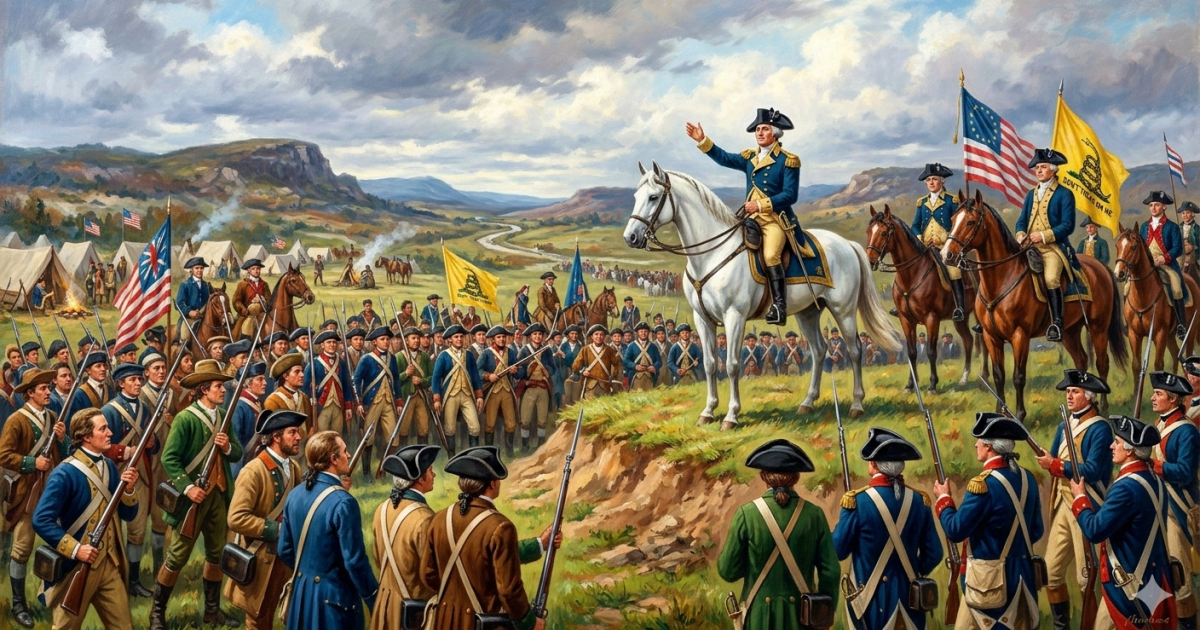
One of the most inspiring American pre-battle speeches of all time was also one of the first, delivered before a battle that would help determine whether the American experiment would succeed or fail, and whether the new nation could be born and survive. General George Washington addressed the troops on July 2, 1776, in General Orders before the Battle of Long Island, the day the largest British fleet ever seen in North America arrived.
“The time is now near at hand which must probably determine whether Americans are to be freemen or slaves; whether they are to have any property they can call their own; whether their houses and farms are to be pillaged and destroyed, and themselves consigned to a state of wretchedness from which no human efforts will deliver them. The fate of unborn millions will now depend, under God, on the courage and conduct of this army. Our cruel and unrelenting enemy leaves us only the choice of brave resistance or the most abject submission. We have, therefore, to resolve to conquer or die.”
There are a number of commonalities between great pre-battle messages, and Admiral Cooper hit them all. First, every single one frames the battle as a hinge point in history. Washington says the fate of “unborn millions” depends on this army. Eisenhower calls it a “Great Crusade.” Cooper tells the troops that they will change the course of history. And in the opening salvo, he says, “The time for preparation is over. The time for action has arrived.”
Every great pre-battle message contains an affirmation of the cause’s righteousness. All four grounded the mission in moral legitimacy. Washington frames it as freedom versus slavery. Eisenhower invokes “liberty-loving people everywhere.” Schwarzkopf cites the president, Congress, and the world community, institutional validation of righteous purpose. Cooper states, “Since 1979, the Iranian regime has killed and wounded thousands of Americans, and they continue to threaten Americans and our friends.” This is Cooper’s justification. Nearly half a century of Iranian aggression against Americans frames the mission as morally overdue.
The soldier is not alone. Every message tells the troops they have powerful forces behind or beside them. Eisenhower says the hopes and prayers of the free world march with them. Schwarzkopf explicitly lists the president, Congress, allies, and the world. Washington invokes God. Even Patton’s message implies collective action, “you must attack,” not as individuals but as a force.
Cooper wrote, “By order of the President of the United States, we are embarking on a mission of profound consequence.” He added, “You represent the strongest, most lethal warfighting force the world has ever known.” Cooper invokes both the commander in chief’s authority and the collective power of all six branches, “soldiers, sailors, Marines, airmen, guardians, and Coast Guardsmen.”
Acknowledgment of the difficulty ahead: none of them sugarcoat what is coming. Washington offers only “brave resistance or abject submission, conquer or die.” Eisenhower admits the enemy is “well trained, well equipped, and battle-hardened.”
Schwarzkopf calls the enemy an aggressor worthy of the greatest force ever assembled. Patton is the most direct. He tells soldiers flat out that they will be afraid.
Cooper’s message similarly states, “Combat is inherently chaotic. The hours, days, and perhaps weeks ahead will challenge you. There will be noise and confusion.” This is Cooper’s most Patton-like moment, no false promises, no sanitized picture of what is coming.
A direct call to action: each message ends or pivots on a command. Washington’s is “conquer or die.” Eisenhower’s is “we will accept nothing less than full victory.” Schwarzkopf’s is “you are ready.” Schwarzkopf’s is “you are ready.” Patton’s is “shoot and keep shooting.”
Cooper gives three explicit commands, making him the most operationally specific of all five commanders: “Be relentlessly lethal. In the heat of conflict, remember who you are. Let your conduct be as professional as your aim is precise.”
“Take care of your teammates. The men and women on your flanks, in front of you, and those at your six are your guardian angels. Be theirs.”
“Steady your resolve. Fall back on your training. It is the best in the world.”
The commander’s personal voice is unmistakable and personal. In all great pre-battle messages, you hear the man behind the words. Washington’s gravity, Eisenhower’s measured confidence, Schwarzkopf’s institutional authority, Patton’s brutal directness. None read like committee documents.
Cooper writes, “I write to tell you how honored I am to serve with you, the most exceptional soldiers, sailors, Marines, airmen, guardians, and Coast Guardsmen on this earth. You all selflessly serve our great country and make us so very proud.”
He closes, “You are the shield of the free world, and today you are its sharpest sword. As the eyes of the world fix upon us, stay safe, and Godspeed.”
And finally, the admiral’s letter will be remembered because Operation Epic Fury marks a historic return of the United States to its original mission, as stated by John F. Kennedy in his inaugural speech: “Let every nation know, whether it wishes us well or ill, that we shall pay any price, bear any burden, meet any hardship, support any friend, oppose any foe to assure the survival and the success of liberty.”
The military operation to end Iran’s repressive Islamic regime is one of the most morally justified conflicts since World War II. It is an example of Americans going to war to make other people free, while NATO, the EU, and the UN stand by and do nothing but criticize.
The post Commander’s Messages on the Eve of Iran Battle CENTCOM Commander Follows Historic Tradition appeared first on The Gateway Pundit.