
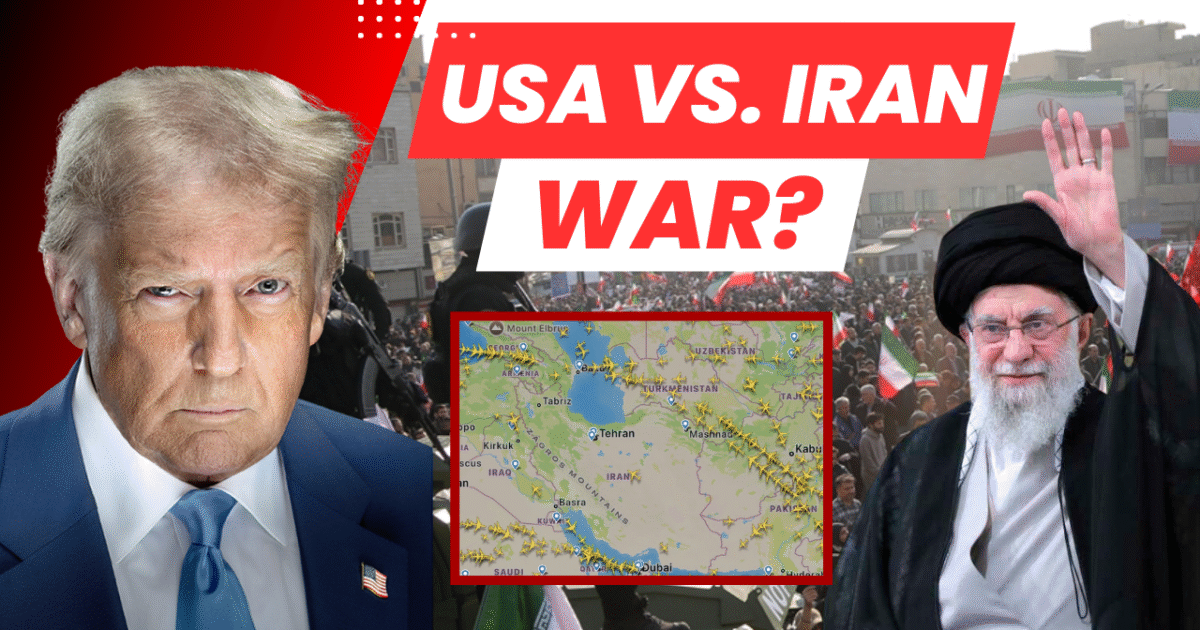


WATCH: Interview with Daniel Greenfield, expert in U.S. Middle East foreign policy and CEO of the David Horowitz Freedom Center.
Every new wave of unrest in Iran produces the same reaction in Washington. Commentators begin predicting airstrikes, social media circulates claims about “imminent action,” and the debate turns into a narrow question of whether the United States will strike Iranian territory.
That framing misses the central issue. The challenge inside Iran is not a contest between two armies. It is a contest between a population trying to organize and a regime that retains power because it can suppress coordination before it spreads.
The Islamic Republic’s decisive edge is operational rather than ideological: its security apparatus acts with greater speed and coordination than the protesters it seeks to suppress.
That advantage depends on internal communications networks, surveillance systems, and rapid-deployment units tied to the IRGC and the Basij.
When the regime shuts down the internet, blocks cellular service, or deploys its paramilitary forces into cities, it is relying on a structure designed to prevent the public from organizing at a pace that threatens state control.
This is why the familiar discussion about “airstrikes” misunderstands the problem. Iran briefly closed its airspace this week, which led to speculation about a U.S. strike package.
The more useful observation is what that closure signals: the regime’s biggest fear is not destruction of infrastructure that can be rebuilt. Its biggest fear is disruption of the systems that allow it to direct repression.
A targeted operation that disables specific command nodes or interferes with surveillance capability would affect Iran’s internal balance more than a conventional strike on hardened facilities.
The confrontation is occurring inside urban neighborhoods, where control depends on information flow and speed, not large-scale military assets.
The IRGC and Basij form the backbone of this system. They enforce compliance through arrests, rapid crowd dispersion, and lethal force. The United States cannot and should not promise a direct path to regime change.
Iran’s political structure is distributed enough that removing individual leaders would not dissolve the apparatus underneath them.
But the United States can influence the environment in which Iranian citizens are resisting.
Operations that disrupt censorship systems, slow the deployment of rapid-response units, or limit coordination among enforcement agencies would raise real costs for the regime without committing American forces to a long-term presence.
This also clarifies a recurring argument in American politics. Pressure on Iran is often framed as an action taken on behalf of another country. That claim ignores the strategic burden Iran already imposes on the United States.
American bases and naval deployments across the region exist largely to deter Iranian activity.
Weakening Iran’s internal enforcement capacity reduces threats to American personnel, lowers the probability of regional escalation, and limits the IRGC’s ability to project force through proxies.
Those are outcomes that directly affect American security.
Regime change cannot be treated as a single action. Iran’s leadership networks can regenerate even after major losses.
The attainable objective is more specific: make repression harder to execute, make coordination among protesters easier to sustain, and increase the operational costs for the units responsible for violence.
If Washington limits the conversation to whether it will “bomb Iran,” it will overlook the only question that decides outcomes: whether U.S. policy focuses on the regime’s control systems rather than symbolic displays of force.
The quieter approach is the one that shifts the balance on the ground.
Listen: Interview with Daniel Greenfield, expert in U.S. Middle East foreign policy and CEO of the David Horowitz Freedom Center, HERE.
The post EXCLUSIVE: The U.S. Has More Iran Options Than You’ve Been Told appeared first on The Gateway Pundit.