


Chinese Defense Ministry spokesperson Zhang Xiaogang said Xi Jinping’s 2026 New Year message energized the People’s Liberation Army (PLA) and reinforced their commitment to China’s modernization goals.
He stated that the military will study and implement Xi’s guidance by strengthening political loyalty, advancing reform, technology, and personnel development, and accelerating integrated military modernization through mechanization, informatization, and intelligent technologies.
Zhang went on to claim that the aim is to boost combat readiness and build strategic capacity to defend China’s sovereignty, security, and development interests while moving toward the goal of a world-class military.
The term “China’s sovereignty” is used by the Chinese Communist Party (CCP) to justify the forcible annexation of Taiwan.
A blockade and invasion of the island nation have become the focus of many People’s Liberation Army training scenarios.
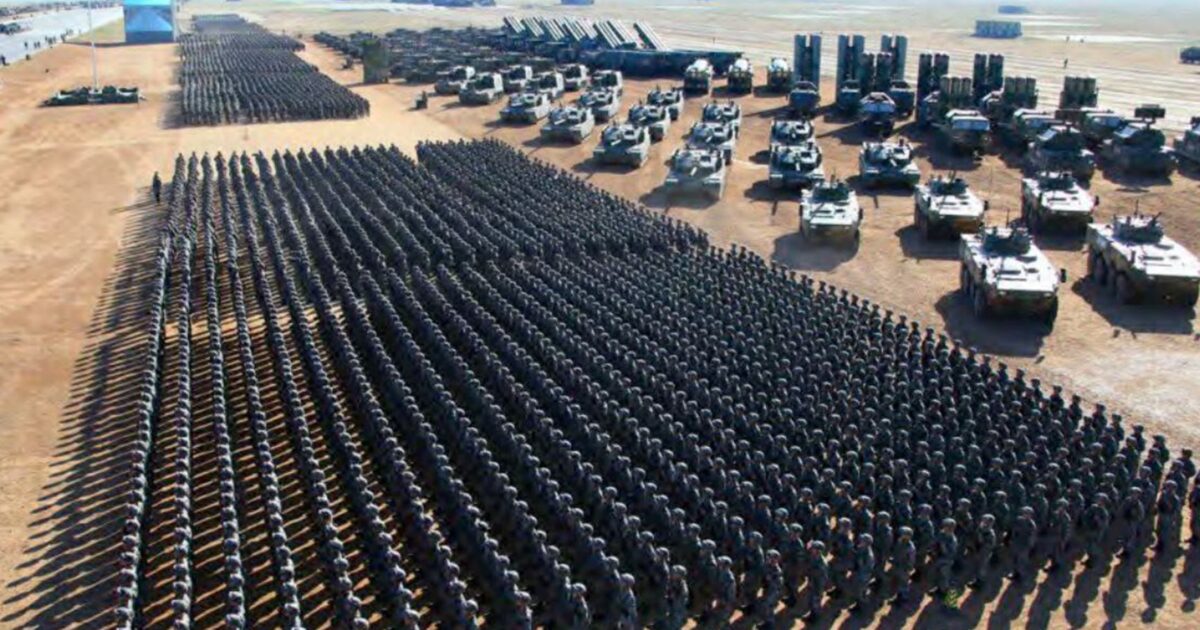
The People’s Liberation Army began its annual 2026 training cycle on January 4 with large-scale combat drills integrating air, naval, ground, rocket, and support forces under realistic wartime conditions.
The exercises emphasize rapid transition from peacetime to combat readiness, joint-force integration, and command coordination, reflecting Beijing’s focus on high-intensity, multi-domain warfare amid rising regional competition.
The drills incorporated the military’s most advanced weapons and systems, including J-20 stealth fighters, Type 055 destroyers, DF-17 hypersonic missiles, and unmanned systems.
The Hong Kong Garrison also held a mobilization ceremony on January 4 to launch its training year, integrating Army, Navy, and Air Force units stationed in the territory.
In addition to providing a training opportunity, the drill also serves to remind the people of Hong Kong that they are subjects of Beijing and should not entertain any illusions of independence or autonomy.
Ground forces training centered on live-force small-unit combat, with the 79th Group Army conducting assaults using integrated unmanned systems.
These exercises combined reconnaissance drones, bomb-dropping drones, smoke-laying drones, and FPV loitering munitions alongside robotic platforms, illustrating a doctrinal shift toward “intelligentized warfare” in which unmanned systems act as force multipliers in close and urban combat.
Units conducted live-fire integration exercises designed for battlefield flexibility and adaptability.
China has confirmed the operational deployment of its new Type 19 8×8 wheeled armored fighting vehicles with frontline units following the release of training footage by state broadcaster CCTV.
The video shows units from the 149th Medium Combined Brigade of the 76th Group Army conducting maneuvers during the opening phase of the PLA’s 2026 annual training cycle.
The Type 19 is an advanced evolution of the earlier Type 08 family and reflects the PLA’s shift toward more mobile, modern wheeled armored formations.
Variants include infantry fighting and assault versions armed with either unmanned 30mm turrets or a 105mm gun.
The infantry fighting variant features a remotely operated turret equipped with a 30mm cannon, coaxial machine gun, and anti-tank guided missiles.
The vehicle combines high-strength steel and modular composite armor, offering protection against small arms fire and improved mine resistance at a combat weight of roughly 25 tons.
Training emphasized rapid deployment, infantry-vehicle coordination, and combined maneuver operations in open terrain under winter conditions consistent with western China’s geography.
Naval drills were conducted by a destroyer group sailing from Qingdao and included complex ship handling, live-fire gunnery against surface and coastal targets, decoy-assisted firing, anti-frogman defense, and emergency navigation scenarios such as power loss and hull breaches.
Multiple warships departed for combat-oriented exercises that include single-ship and formation maneuvers, weapons operations under complex weather conditions, and navigation training in high-risk scenarios such as narrow waterways, power failures, and onboard flooding.
The People’s Liberation Army has released footage showing naval exercises focused on countering swarms of suicide drones.
State broadcaster CCTV showed a naval unit simulating ultra-low-altitude drone swarm attacks against maritime targets, with PLA forces responding using ship-borne missiles and interception systems.
The drills recreated multi-wave attack scenarios to test counter-drone capabilities under realistic battlefield conditions. The exercises reflect the PLA’s close study of suicide drone warfare, which has become central to Taiwan’s asymmetric defense strategy.
Taiwan has drawn lessons from the war in Ukraine, investing in loitering munitions to offset China’s conventional military advantages, including the purchase of around 1,000 suicide drones from the United States in 2024.
Taipei has also worked with U.S. defense firm Kratos to convert the MQM-178 Firejet target drone into a long-range, high-speed suicide drone designed for precision strikes.
Chinese analysts view missile-based defenses against drone swarms as effective but costly, prompting Beijing to expand non-missile counter-drone options. The PLA has showcased systems such as anti-drone artillery, high-energy lasers, and microwave weapons.
Air Force units launched routine training with J-20 stealth fighters, immediately transitioning into confrontational exercises such as beyond-visual-range air combat.
Nighttime refueling, long-duration flights, and operations in distant seas, plateau regions, and border areas are now described as standard practice.
The Rocket Force conducted opening drills, rapidly deploying to field positions and executing launch procedures.
Footage confirmed the participation of the DF-17 hypersonic missile, previously displayed at the September 2025 V-Day military parade in Beijing.
The system was shown erected on transporter erector launchers and integrated into regular combat preparation.
The DF-17’s maneuverability and ability to evade missile defenses make it a system for striking high-value targets across the Western Pacific.
Logistics and armed police units also carried out inaugural training, underscoring a system-wide focus on joint operations, integration of new equipment, and accelerated combat readiness.
The drills brought together advanced platforms across the People’s Liberation Army, signaling that these capabilities are now part of routine operational training.
The Chinese Communist Party actively promotes videos of these large-scale training exercises on Chinese and international social-media platforms as a warning to Taiwan, the United States, and Japan.
Zhang addressed Japanese grievances over frequent China Coast Guard patrols near the Senkaku Islands, known in China as Diaoyu Dao, reaffirming China’s claim to the territory and describing the patrols as legitimate law enforcement actions in waters under Chinese jurisdiction.
Japan claims the islands as sovereign territory, and the United States is committed under the U.S.–Japan defense agreement to defend them if China were to attempt annexation.
Zhang dismissed criticism and warned Japan to act cautiously to avoid escalating tensions, stating that any provocation would be self-defeating.
He also criticized Japan’s recent security policies, including discussions of nuclear armament, possible acquisition of nuclear-powered submarines, and expanded defense assistance to Southeast Asia.
He accused Japan of accelerating remilitarization, exporting weapons, and reviving militarist ambitions without reckoning with its wartime history, and called on regional and international actors to oppose these moves and uphold the post-war international order.
The post China’s People’s Liberation Army Begins Annual Training Cycle, Focuses on Taiwan, Threatens Japan appeared first on The Gateway Pundit.