
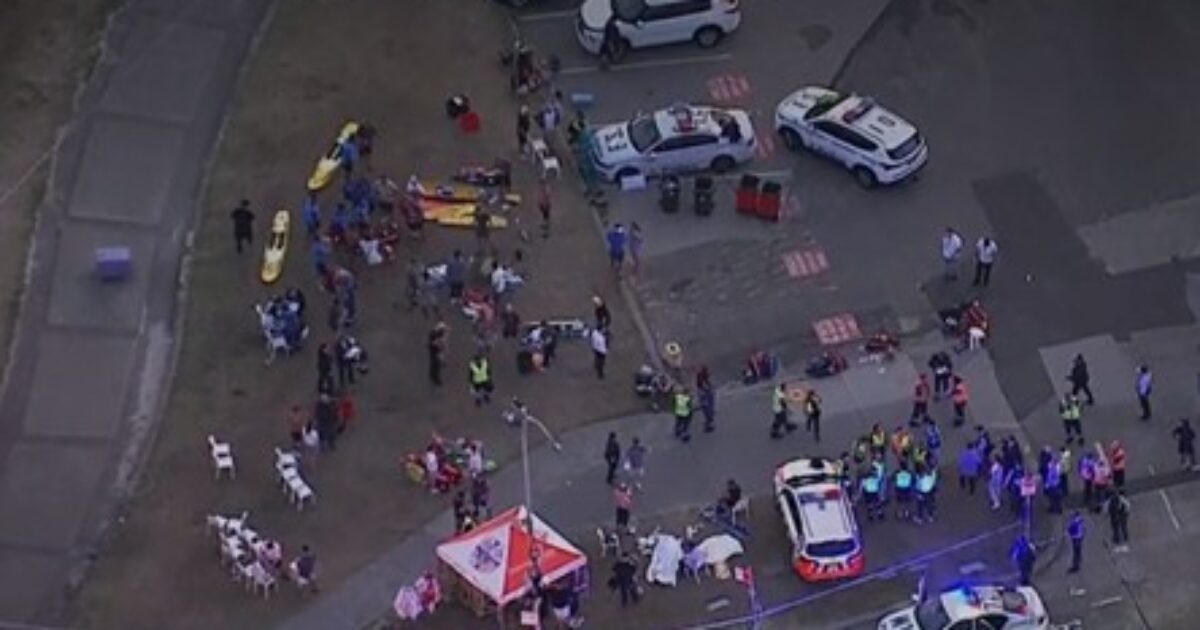


The mass-casualty terror attack targeting a Hanukkah gathering at Sydney’s Bondi Beach was the predictable outcome of a global environment in which antisemitic incitement is normalized, rationalized, and, in some cases, actively encouraged by state actors.
In the hours following the attack, attention has turned to Iran—not because Tehran immediately claimed responsibility, but because of how Iranian officials, state media, and regime-aligned commentators have responded.
Iran’s reaction follows a familiar pattern. There has been no direct praise for the murders.
Instead, Iranian outlets have worked to reframe the attack as an understandable—or even defensible—reaction to the Israel-Hamas war, while redirecting outrage toward Israel and the West.
This strategy allows the regime to distance itself from operational responsibility while sustaining the ideological climate that fuels antisemitic violence worldwide.
Iranian state media coverage was notably clinical on the surface. The Islamic Republic News Agency (IRNA), Tehran’s official media, reported the basic facts: a shooting at a Jewish Hanukkah celebration, multiple fatalities, and ongoing investigations by Australian authorities.
Missing, however, was any moral condemnation of the attack or recognition of antisemitism as a motivating factor. Instead, IRNA quickly pivoted, characterizing Israeli reactions as “harsh” and “unprecedented” and situating the massacre within the broader narrative of Gaza.
Iranian coverage repeatedly emphasized claims about civilian deaths in Gaza, citing figures from Hamas-run authorities and presenting them as uncontested fact.
The implication was clear: violence against Jews abroad should be understood through the lens of Israel’s military actions, rather than as terrorism targeting a religious minority.
By embedding the Bondi Beach attack within a Gaza-focused narrative, Iranian media effectively shifted blame from the perpetrators to Jewish collective identity itself.
That narrative was taken further by regime-aligned commentators. Lebanese journalist Hadi Hoteit, who identifies himself as a correspondent for Iran’s state-run Press TV, posted on social media questioning whether the attacker should even be labeled a terrorist.
He framed the killings as retaliation against people allegedly complicit in a “genocide” spanning decades.
The language mirrored Tehran’s official rhetoric almost verbatim.
While not an official government statement, such commentary reflects the ideological ecosystem Iran cultivates—one in which antisemitic violence is morally relativized or excused.
This matters because Iran is not merely a commentator on regional conflicts. It is the world’s leading state sponsor of terrorism, according to the U.S. State Department, providing funding, weapons, and training to groups such as Hezbollah, Hamas, Palestinian Islamic Jihad, and the Houthis.
These organizations do not limit their activity to the Middle East. Hezbollah operatives have been arrested or monitored in Australia, Europe, and Latin America, and Australian intelligence agencies have long warned about foreign extremist influence operations targeting diaspora communities.
Iran’s strategy relies on plausible deniability.
Tehran rarely claims direct involvement in attacks outside its immediate sphere of influence. Instead, it exports ideology, propaganda, and operational know-how through intermediaries and sympathetic networks.
When violence occurs, Iranian media shifts to narrative management—deflecting responsibility, amplifying anti-Israel outrage, and portraying perpetrators as products of Western or Israeli actions rather than extremist indoctrination.
At the same time, Iranian officials have sought to project calm and diplomatic restraint. In the days before the attack, IRNA prominently featured statements from Iranian leaders emphasizing diplomacy, regional cooperation, and economic partnerships.
President Masoud Pezeshkian highlighted the importance of BRICS as a counterweight to Western influence.
Foreign Minister Abbas Araghchi reiterated that Iran “does not seek war” and prefers dialogue.
Meetings with officials from Turkey, Pakistan, and Ethiopia were showcased as evidence of Iran’s constructive international engagement.
This dual-track messaging is deliberate. Domestically and ideologically aligned audiences receive constant incitement against Israel and Jews, while international observers are presented with a sanitized image of Iran as a rational actor concerned with stability.
The contradiction is a core of Tehran’s information warfare strategy.
The Bondi Beach attack also fits within a broader surge in antisemitic violence across Western democracies since October 2023. According to Australian government data, reported antisemitic incidents have risen dramatically over the past year, with Jewish community organizations documenting spikes in threats, vandalism, and physical assaults.
Similar trends have been recorded in the United States, Canada, the United Kingdom, and across Europe.
Iranian-backed media outlets and social-media networks have played a measurable role in amplifying inflammatory narratives during this period.
Iran’s response to the Bondi Beach massacre, therefore, cannot be assessed in isolation.
By excusing the violence, contextualizing it as political grievance, and refusing to condemn antisemitism outright, Tehran reinforces the same ideological framework that has fueled attacks from Buenos Aires to Burgas to Toulouse, and now to Sydney.
The post Iran’s Response to Australia’s Bondi Beach Terror Attack Raises Questions appeared first on The Gateway Pundit.